Reference: RT107

Date: 29-Nov-94

Author: Ray Tomes

Email: rtomes@kcbbs.gen.nz
The 72km/s red-shift quantisation of inferred galaxy
velocities is explained and a number of other quantisations
predicted. This paper is more easily understood after
reading the author's earlier paper:-
RT103 Harmonic Theory Overview.
That paper shows how, in non-linear systems satisfying
certain conditions, a particular pattern of harmonics will
develop from a fundamental frequency. Particularly
powerful harmonics are predicted for frequencies of 2880
and 34560 of the original. Other powerful harmonics are
predicted at these multiplied by and divided by small
integers, particularly 2, 3, 4, 6, 8, and 12.
Under the harmonic theory, the most common harmonic is 2.
For this reason, the distance over which a red-shift
exactly doubles a wavelength is very important, because
doubling the wavelength is the same as halving the
frequency. Halving the frequency means that when combined
with the predicted harmonic structure which includes a
harmonic of twice the original frequency, we have feed-back
of energy. This relationship allows a dynamic equilibrium
of energy in the universe.
The distance over which wavelengths double is
c ln 2
------ (where H is the Hubble constant)
H
and the interpreted velocity of recession at this distance
is c ln 2 which is 207,800.297 km/s. The most important
harmonics predicted are 2880 and 34560 which correspond
respectively therefore to apparent recession velocities of
72.1528809 and 6.01274008 km/s. The first may be
interpreted as the galactic cluster quantum and the second
as the galaxy quantum. The first has been extensively
reported with values stated to be of 72 and 72.4km/s.
See the many papers by Tifft and Arp and their references.
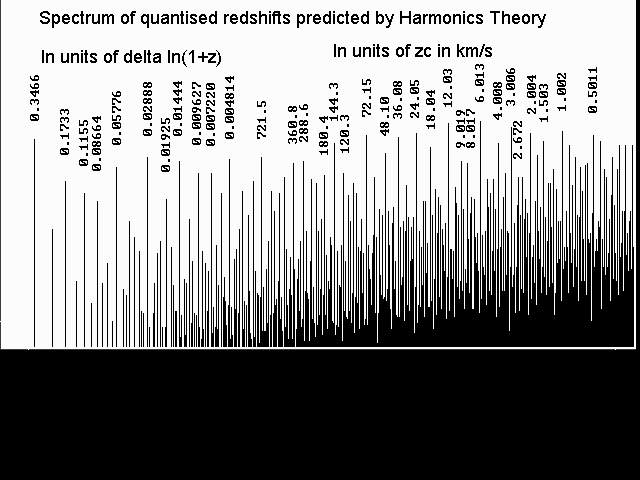
Below is a spectrum of the more important harmonics and
the predicted apparent recession velocities.
I have found evidence of several others of these in data
on galaxies, and so have others such as Arp.
The predicted quantisations are not strictly in the
velocities, but rather in delta log(1+z). This has also
been pointed out by Arp. For harmonic number h, the value
of delta log(1+z) is ln (2^(1/h)) or more simply (ln 2)/h.
The values for the velocity quanta are for the first order
only, and vary for higher orders.
Harmonic delta delta
Number log(1+z) velocity
(km/s)
1 .693147 207800. *
2 .346573 103900.
4 .173286 51950.1
6 .115524 34633.4
8 .0866433 25975.0
12 .0577622 17316.7 *
16 .0433216 12987.5
24 .0288811 8658.34 *
48 .0144405 4329.17
72 .00962704 2886.11
96 .00722028 2164.59
144 .00481352 1443.06
192 .00361014 1082.29
288 .00240676 721.529
576 .00120338 360.764
1152 .000601690 180.382
1440 .000481352 144.306
2880 .000240676 72.1529 *
5760 .000120338 36.0764
8640 .0000802253 24.0510
11520 .0000601690 18.0382
17280 .0000401126 12.0255
23040 .0000300845 9.01911
34560 .0000200563 6.01274 *
51840 .0000133709 4.00849
69120 .0000100281 3.00637 *
103680 .00000668544 2.00425
The quanta marked with an asterisk are the most powerful
predicted harmonics. There are very many lesser ones not
listed here. These predicted redshift periodicities are shown
in the figure below.
Since I first calculated these values, there have been
reports of a 37.6+-2.0 km/s quantum (cf. 36.1 predicted)
and a number of reports of values from .0565 to .060 c
(cf. predicted .0578 c). I have found the 8660 km/s
(or .0289 c) quantum in tables of galactic red-shifts
on several occasions.
It is my intention to obtain a large database of galaxy
red-shifts and look for the details of this structure in
the data. I am announcing the expected results in advance
here (as above) and will report again once the analysis
is complete.
NOTE: The results of two analyses by W G Tifft are reported
in the article RT115.
Next
Email: Ray Tomes